
BARS Training
& Calibration Facilitator Guide
This guide walks you step-by-step through the full process of preparing, training, and calibrating BARS observers.
Prior to reading this guide, you should have already identified which BARS rubric(s) you intend to use as assessment tool(s) for your event. If this is not the case, please reach out directly to your Cognitive Performance Group representative.
Reviewing this guide should take approximately 30 minutes.
Purpose of This Guide:
This guide gives you the foundational understanding and reference materials you need to perform your role as a BARS Calibration Facilitator.
It provides clear explanations, examples, and tools that will help you prepare effectively, understand the structure of BARS, and support observers through the training calibration process. This guide will help you:
Build foundational knowledge of BARS
Learn essential terminology and rating logic
Become familiar with key facilitator tools
Understand how training materials support calibration
Learn the structure of the facilitation process
Recognize what supports reliable, aligned scoring

Facilitator Development Steps:
These steps provide an overview of the actions you will complete as you work through this guide to become a BARS Calibration Facilitator.
Step 1:
Prepare for Your Calibration Session
You Will:
-
Understand the BARS structure & rating anchors
-
Review the key tools and materials you will use
-
Select your calibration event
Step 2:
Conduct Your Training
& Calibration Session
You Will:
-
Teach observers how to identify & rate behaviors
-
Lead the calibration discussion
-
Guide the group to scoring alignment
Step 3:
Prepare Observers for Live BARS Collection
You Will:
-
Provide assessment mechanism to observers
(e.g., paper rubric, digital collection tool) -
Set expectations for live scoring
-
Ensure readiness for accurate data collection
The sections that follow will take you through each step of the facilitator process.
1.4
Prepare the Observers for the Calibration
Provide the
Observers with:
A printed version of the BARS rubric (preferred)
A digital version (Excel, Forms, PowerApps, etc.)
Your Tasks:
-
Allow observers enough time to review the rubric before calibration.
-
Train observers on the digital collection tool interface, if being used.
-
Brief them on the structure of the event and what they will be asked to do.
To eliminate administrative friction before the calibration begins.
Your Goal:
1.3
Select a Calibration Event

What is a Calibration event?
A calibration event is a rating practice session and facilitated discussion using a standardized scenario. The purpose is to build shared understanding and scoring alignment.
Calibration events may include an official calibration video developed for specific BARS rubrics, a relevant video clip selected by the facilitator, or a live exercise in which observable performance closely mirrors the conditions of upcoming rating sessions. The live exercise is the ideal calibration format because it provides observers with real-time, context-rich performance that closely reflects the conditions, complexity, and behavioral cues they will encounter during actual rating sessions. To get the best alignment and calibration among your observers, select a calibration event that most closely matches the events they need to rate.
Choose from options below:
Option 1:
If you have already identified your calibration event,
proceed to Step 1.4 Preparing Yourself for the Calibration Session.
Option 2:
If you are using the Collective Squad BARS or Platoon Commander BARS rubrics, you can access their associated calibration videos here:

1.2
Review the Facilitator Guide
What is it?
A structured reference that outlines the full sequence of BARS training, calibration, and observer preparation, including key talking points and facilitator actions.
What do I do?
Use it to plan and deliver the session, following the guidance to ensure consistent instruction, effective calibration discussions, and clear preparation for live data collection.

1.1
Review BARS Background & Calibration
Exemplar Videos
What is it?
A concise, 20-minute instructional video that explains:
-
What BARS are
-
Why we use BARS
-
How a rating is derived from observable behavior
-
How indicators and anchors work
What you should do...
-
Review the video prior to the session to help you prepare for questions your observers may have.
-
Show the video during the BARS Training and Calibration Session
-
Be prepared to answer questions that stem from it
-
Refer back to the video throughout your session if needed

3.
Prepare Observers For Live
BARS Collection
Now that the observers have been properly trained and calibrated, there are pieces of information about the live BARS collection that must be discussed and communicated to the observers before live BARS collection can begin.
In addition to the BARS rubric itself, there are a handful of pieces of information that must be collected along with each BARS rubric. These items, called parameters, are essential for data management and analysis. Without these items being completed correctly, the collected BARS data may end up useless.
Download the BARS Session Parameter Guide to understand the parameter items and what guidance to provide to your observers for those items. If you are using MS forms as your collection medium, refer to the BARS Session Parameter Guide (MS Forms) document.

We have identified a number of lessons learn to support more efficient and accurate BARS collection. Download and present the BARS Rating Tips to the observers prior to collection.

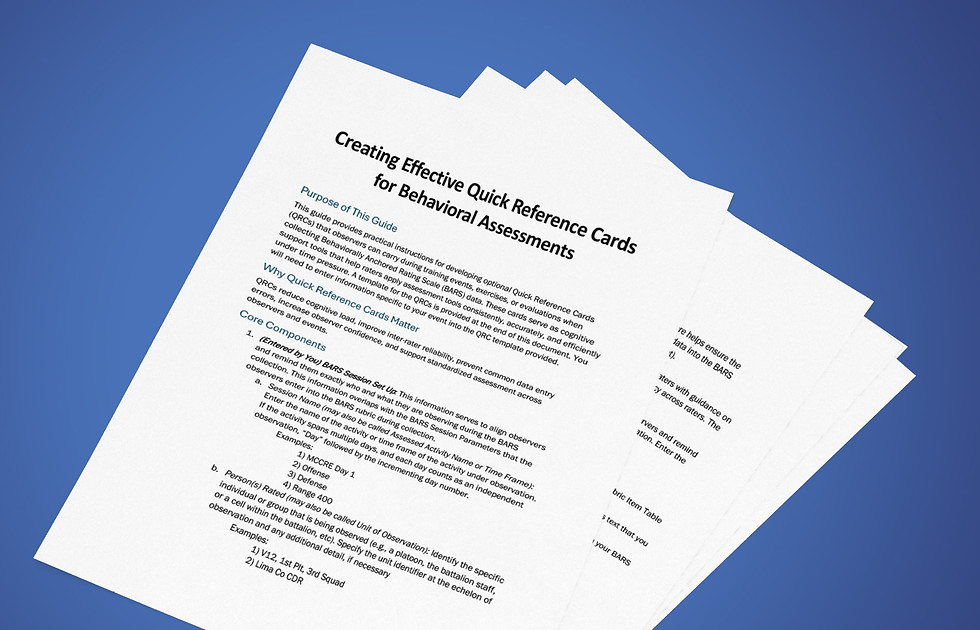
We have found that many observers do not complete the BARS in real-time, but rather take notes during observation and complete the BARS rubric at a later point. As such, we have developed a template to allow users to generate Quick Reference Cards for observers to carry in their pockets to remind them of the topic areas to pay attention to during observation. Download and edit the template to provide Quick Reference Cards to your observers.
2.
Conducting Your Training
& Calibration Session
Apply the Facilitator Guide to carry out your training and calibration session. The full session should take approximately 90 minutes depending on the length of the calibration event.
90 minutes
approx.
Training & Calibration Session
To prepare for conducting your BARS training and calibration session, you will review a series of materials presented below. Some of these materials are strictly for preparing you to lead the calibration session, and others are materials you will present to the observers you train and calibrate.
1.
Prepare for Your Calibration Session
Change the text and add your own content, including any information that is relevant to share.
This is a paragraph where you can include any information you’d like. It’s an opportunity to tell a story about the company.
Describe a feature you’d like to share about this company or highlight a particular service it offers.
Curated sets
Change the text to include your own content. Adjust the font, size or scale to customize the style.


Change the text and add your own content, including any information that is relevant to share.
+122%
Change the text and add your own content, including any information that is relevant to share. Then customize the font, size and scale to make it your own.
Change the text and add your own content, including any information that is relevant to share. Then customize the font, size and scale to make it your own. You can also drag and drop this text box anywhere on the page, or switch it out with another element.